
Tales from the Archives No. 1, December 2023
An academic’s assassination, gun boat diplomacy and blood money
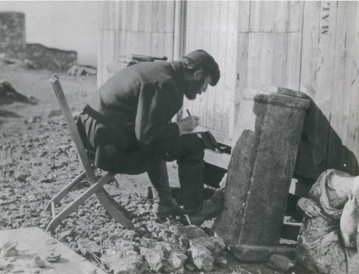
Herbert DeCou hard at work on the site’s epigraphy, Cyrene, 1911
Walking up to the acropolis of the Graeco-Roman city of Cyrene in the Jebel al-Akhdar (Green Mountain) of eastern Libya, to begin the working day on March 11th 1911, Herbert DeCou was killed with two shots to the chest from close range. Three men then mounted horses and galloped off. A contemporary photograph is literally annotated with an ‘X’ to mark the exact spot. What had DeCou, a mild-mannered Michigander, done to trigger his terribly efficient execution? As epigrapher on the first – and only – season of excavation at the site under the aegis of Richard Norton and the Archaeological Institute of America (AIA), DeCou (1868-1911) was by all accounts a well-respected academic and a shy, self-effacing man.
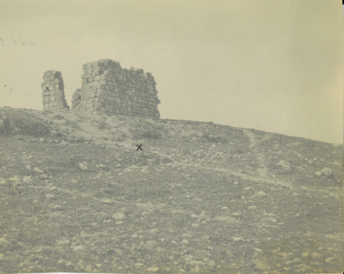
Site of DeCou’s death on the slope of the acropolis, Cyrene, 1911, written by Norton on the verso, ‘The place where he fell is marked with a cross’.
Some answers lie within the archives of the late Professor Joyce Reynolds within which are nested older documents, inherited by her from the British archaeologist Richard G. Goodchild (1918-1968). From 1953 to 1966 Goodchild was appointed by the Libyan government to oversee the province of Cyrenaica’s antiquities service. During his tenure, Goodchild undertook archival research in the University of Michigan in 1967. He wanted to ascertain the cause of DeCou’s assassination, which came on the eve of the Italo-Turkish war of 1911, when Libya remained part of the Ottoman empire while Italy sought colonial expansion. Richard Norton (1872-1918), a Bostonian and curator at the Museum of Fine Arts, was keen to excavate Cyrene, which rose to wealth and fame in antiquity as the chief exporter of the plant silphium (now extinct but used as everything from a condiment to an aphrodisiac).
In the immediate aftermath of DeCou’s murder, who was most probably mistaken for the expedition’s leader, members of a subdivision of the Hasa tribe were identified as the assassins. Boldly, Norton stated that the Arabs were in the pay of the Italians. In response, Norton intended to return to the dig in September 1911 on the gun boat USS Chester to make his point that excavation would continue. However, the Italo-Turkish war broke out that very month on the Libyan coast thereby halting all plans for archaeology.
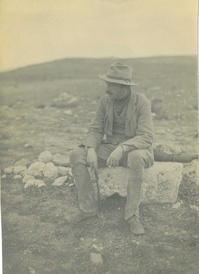
Richard Norton, Cyrene, March 1911
Norton ultimately rescinded his accusations of Italian nefariousness at state level, although he believed the Italian consul in Benghazi had plotted to repel American presence in Cyrene. The diaries of Richard Sladden, an English doctor who was part of the 1911 expedition, did not deliver conclusions for Goodchild, who believed the tangled chain of events and motivations remain to be discovered in closed diplomatic archives. In 1913, to smooth matters over, the Italian government, whose nationals were emigrating in large numbers to the USA, agreed to pay a voluntary indemnity of $25,000 in compensation for DeCou’s murder: blood money. This became the Cyrene Fund, still in existence at the AIA.
Meanwhile, DeCou’s grave remains at Cyrene, well-tended and facing westwards towards his homeland.
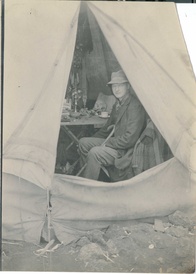
Richard Sladden in his tent, Cyrene, Feb. 1911