Mill Lane Memories
Missing Books
Regular readers will know that we are sampling the papers of the Mill Lane Classics Library in search of times past…on this occasion we take a look at that hardy perennial, missing books. During the 1940s and 1950s, few books ‘go missing’, even if the scenarios seem sometimes curiously familiar...
Classical Faculty Library Report 1943-44
p.2 Losses during the year have been small, amounting to three Loeb volumes – always an easy prey for dishonest persons, owing to their smallness and portability…
CFL Report 1945-46
Losses 5 volumes were lost…just before the end of Easter Term…It was hoped that they might be returned during the Long Vac. Term, but up to the present they have not re-appeared. Such books do however sometimes turn up again in October.
CFL Report 1946-7
Losses The number of volumes missing over the whole period since the original opening of the Library [in 1933] is 42…
4 volumes only have disappeared during the past eleven months.
3 missing volumes from the Loeb Series were restored by Messrs Bowes, who found them amongst books offered for sale by a student going down.
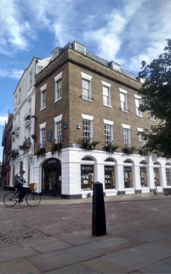
The former premises of Bowes & Bowes, booksellers, located at the corner of St. Mary’s Street and Trinity Street, are now occupied by the CUP Bookshop.
And consider the following vignette, worthy of inclusion in a production by the Ealing Film Studios:
Letter from Professor Donald Robertson [Regius Professor of Greek] to Miss Norah Jolliffe [Faculty Librarian, 1939-50] dated 18/4/47, and held with the Jolliffe papers in Girton College Archive.
The writer alludes feelingly to a former student:
…the bane of many lives, including mine… She used to live at Mrs Camilla Prior’s and lately wrote to ask her to forward her a lot of things she had dumped there. Mrs Prior found that many of the books were in fact the property of Cambridge libraries, I think mostly Newnham, but they included one from the Classical Faculty Library – volume II of C. Fauriel’s ‘Chants populaires de la Grèce moderne’, Paris 1825…an enormous label forbidding its removal from the Library. I took it back today and with Jackson’s help found, to my relief, that volume I was on the shelves.
[Quoted with the permission of The Mistress and Fellows, Girton College, Cambridge]
The late Margaret Rutherford would have been ideal casting for the role of the amiably inquisitive Mrs Prior! (Mr Jackson served for many years as the Library Clerk). But alas, the carefree days of Ealing Comedy would give way in years to come to the darker tones of ‘kitchen-sink realism’…
From the Report on the Classical Faculty Library dated 30th October 1968:
The stock taking in June revealed a horrifying number of books missing but some of these were returned during the summer, either from college libraries or to the library box on the ground floor of Mill Lane and some have reappeared on the shelves this Term. There are still 41 books missing. Although this rate is not as high as in some faculty libraries and is not up on last year when one considers that it represents one tenth of the annual accessions one realizes the need for increased security and checking which we hope will be provided by the alterations at the entrance of the library.
From the Report on the Classical Faculty Library dated October 21st 1969:
The number of books lost from the Library is slightly down on last year: 38 in June (1968-69: 41) of which 31 are still missing. This represents over 6 per cent of our annual accessions. Books have been returned to the Library from a variety of sources including a Balliol undergraduate attending Fraenkel’s seminar and in Cambridge, the Emmanuel College dustbins.
The formidable Eduard Fraenkel (1888-1970) held the Corpus Professorship of Latin at Oxford from 1935 until his retirement in 1953. However, he continued to give annual seminars for many years afterwards. And further, from the same Report:
The bag-rack in the Library was only installed half way through the year and it will be interesting to see if this provides any check on losses in the future.
From the Report on the Classical Faculty Library dated October 28th 1970:
Page 2: In spite of the new bag-rack the number of books lost from the Library is again up on last year: 60 in June of which 56 are still missing (1968-69: 38). But besides these high losses, over 40 books were returned after dark one evening to the outside steps of Mill Lane Lecture Rooms in June and a case full of modern Greek books were returned to the Library at the end of the Easter Term. None of these books had been signed for. As a result of these incidents and the high losses we have regretfully introduced a regular check on all readers leaving the Library.
Librarian’s Report 1970-71:
47 books were found to be missing at the time of stock-taking, of which 36 are still missing (1969-70: 56). A pile of books was again left late one night on the steps of Mill Lane Lecture Rooms and the top copies were badly damaged by rain during the night. Last year’s similar pile were Part I books; this year they were almost all from the Arch.
Clearly, the august portals of the Ark [or Arch.] were not sufficiently awe-inspiring to deter the pilferers, either! The Museum and Library of Classical Archaeology were located in Little St. Mary’s Lane from 1884 until 1982, and were commonly known as the ‘Old Ark’.
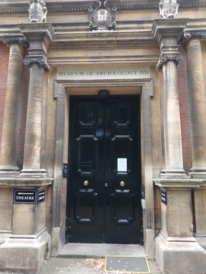
The former Museum of Classical Archaeology in Little St. Mary’s Lane, which now houses Peterhouse Library.
Librarian’s Report 1971-72:
The loss of books from the Library this year has assumed alarming proportions. It has more than doubled since last year. At stock-taking 94 books were found to be missing, and 80 have still not reappeared (1970-71: 36). In the past Loebs have been the main class of books to go missing; today’s offenders are more choosy…As disturbing as these losses is a phenomenon in book vandalism which is new to the Classical Faculty Library. A large number of articles…have been roughly abstracted from periodicals.
That ne plus ultra of library horror, the illicit removal of articles from bound journal volumes, has died out in the last twenty years, due no doubt to the ubiquity of networked electronic resources, laptops and ‘wi-fi’. And book losses would remain a serious problem until the introduction of an electronic security system in the 1980s. Unbound journal issues might also unaccountably vanish…
From a holograph letter dated 3 Nov 1960, headed St. Catharine’s College, addressed to ‘John’ from ‘Pat’:
Finally, may I speak at the Faculty meeting? I merely want to appeal to all to search for Gnomon Fasc II 1960, which someone borrowed without a signature & is not yet back; naturally the dons are the first suspects! [‘Pat’ is W.K. Lacey].
Of course, if offenders can be identified, there remains the ultimate sanction… Librarian’s Report for 1965 [W. Hugh Plommer]:
We have had very little trouble from readers, though I should be grateful if senior members returned books within six months. The only undergraduate to give us serious trouble has just been sent down.
And let us not forget that, while missing books impose additional costs on a Library, wear-and-tear may be significant as well:
Report of the Faculty Librarian, 1960:
The wear and tear on standard texts is appalling. I have had to purchase two or three copies each of rather expensive works like Gow’s Theocritus and Gomme’s Thucydides. The Loeb Library suffers most.
And, Classical Faculty Library Policy dated October 18th 1966:
Of course, some wear and tear and some losses of popular books are bound to result. Some users of Loebs, in particular, have little conscience. This year we had to replace some £100 worth of lost or well-used books.
Moreover, difficulties may arise when libraries are expected to lend things other than books:
Postcard from F.H. Sandbach to Dr Peck, Christ’s College dated ‘14th Dec. 51’.
I was talking this afternoon to the Assistant in the Faculty Library. He tells me that some of the tables and chairs have to be taken into the Palaeography Room for lectures, although there are not enough places in the Library proper to meet the demand. It should surely be the business of the Buildings Syndicate to see that lecture-classes are seated without robbing our Library. This matter would of course be settled at a low level were not the Assistant and the Mill Lane staff at loggerheads: but ‘we’re not going to provide chairs for him’ is their attitude.
Francis Henry (‘Harry’) Sandbach (1903-1991) was appointed to a Cambridge University Lecturership in Classics in 1931, and to a personal Chair in Classics in 1967. His research interests included Latin poetry, Stoicism, Plutarch and Menander. Arthur Leslie Peck (1902-1974) edited several volumes of Aristotle for the Loeb Classical Library, and was a Fellow of Christ’s College.
Finally, we may conclude our schedule of damages with one item of purely historical interest:
Report of the Faculty Librarian, 1961:
We are continuing with the reseating programme: the use of stiletto heels by female students is deleterious, not merely to the floor, but also to the chairs when, by reason of a lack of the necessary height, they mount the chairs to reach the tops of the stacks; at least two chairs this year appear to have been spiked.
Richard Talbert's Memories of Mill Lane
We were delighted to receive this sparkling budget of Mill Lane memories from Classics alumnus Richard Talbert, Professor Emeritus at the University of North Carolina at Chapel Hill, and editor of the magisterial Barrington Atlas of the Greek and Roman World (2000). Richard was an undergraduate at Corpus in the years 1965-68. His Ph.D. (1971) discussed the evidence for the career of Timoleon in Sicily, and for the revival of its Greek zone between 344 and 317 B.C. His supervisors were Harry Sandbach and Moses Finley.
For Cambridge Classics Newsletter
10 July 2025
Dear Molly Willett,
Greetings from the American South. Bruce Logan’s Mill Lane recollections sure cheered up this year’s gloomy July Fourth holiday, and even inspired me to answer your call for others’ tales, modern though mine are by comparison to Bruce’s. I arrived in 1965 and left in 1970, after a 3-year BA and two postgrad years. I’m sorry (as Moses Finley always liked to say), but the news that the Lecture Rooms and Library went to join Nineveh and Tyre in 2022 leaves me unmoved. What a grim, soulless building both outside and in, I always thought. And honestly many of the lectures delivered there were underwhelming too, though by no means all. I’ve remained grateful for striking lucky so often over five years. Frank Goodyear’s course on Tacitus my first year was a brilliant start (just in time – he moved to London in 66).[1] Few attended his opener (on a Thursday?), an absorbing tour de force on the manuscripts and early editions. But word spread, and at the second lecture on Saturday (yes, Saturday morning lectures then!) numbers swelled – which prompted him to grumble half-jokingly that his efforts to deter listeners had backfired. Memorable later was his skill in using the death-of-Vitellius episode to demonstrate differences between Tacitus and Suetonius.
Finley’s lectures were an attraction not least because his New York accent offered a refreshing change from almost everyone else’s BBC English.[2] There was one occasion, however, when general opinion was that he shortchanged us. Without warning, he brought along to his Greek history class a visiting senior colleague – Jacqueline de Romilly?[3] – and said that because she was such an expert on Solon (?), he was inviting her to discuss him. Which she then did for 45 minutes in soft, flowing French, tough for most of us to comprehend or even hear. Then at the next lecture Finley began by remarking that, thanks to Madame de Romilly, we can now move on to a fresh topic. So much for enlightening us on Solon!
For me, most lively, inspiring, passionate was Peter Dronke.[4] He lectured for the recently introduced Mediaeval Latin minor-subject option in Part 2, a choice I’ve always treasured. We read Waltharius, Ruodlieb, the Historia Calamitatum, and much else, opening new horizons, a marvellous experience. I also benefited from more Oxford (!) visitors than might ever have been anticipated. Colin Kraay came from the Ashmolean to deliver the three Gray lectures in my Part 2 year.[5] Though I was blissfully unaware at the time, his third – on Greek coin hoards and circulation – was to prove essential for my PhD thesis.
In 1968 Peter Brunt abandoned Oxford and Classics to become bursar of Caius.[6] He turned out to stay only two years in Cambridge, but during them offered at least one of his Greats courses – on the Augustan period, as I recall. It was heavy going, but perseverance paid off. Not only was he an effective lecturer, but he also distributed notes (typed clumsily, then roneoed on coarse paper – 1960s high tech) specifying in detail the RGDA, Vell, Tac, Dio et al. references for each of his main points. Serious stuff indeed, and invaluable.[7]
An even more unlikely Oxford visitor was Dacre Balsdon.[8] He gave a regular course, by invitation, because it was considered an essential offering, and apparently no-one on the Cambridge faculty could or would fill the slot. Or so went the story on the street. The scope was more or less the Roman Empire during the 2nd and 3rd centuries CE, and he came twice a week (I think), by train. This must have been time-consuming beyond belief, because even the rare fast trains on the condemned Oxford-Cambridge line took two hours, and slow ones almost double that. In fact the axe fell on the line at New Year 1968, so Balsdon must have come in 66 or 67.[9] He turned out to be an elderly don lifted straight from the pages of Brideshead. Something of a showman too, a vigorous speaker with an overblown Awksford accent to set you giggling. Never to be forgotten was his pronunciation of those two colourful emperors Caeraceallllaaah and Eeeelagaahbahlus. But such fluff aside he delivered useful lectures badly needed by most of us, our Roman history being sketchy both before the Gracchi and after Nero.[10] One delicious occasion confirmed the appreciation he earned. He didn’t turn up, and with no news we wondered whether to leave or wait. Then one of the brown-overalled Lecture Room janitors put his head round the door to say that Mr Balsdon’s train had been delayed, but it was now approaching Cambridge station, so please wait – and we did. Other janitors conveyed a stream of further messages in the finest Greek dramatic tradition. “Mr Balsdon is getting into a taxi at the station.” “Mr Balsdon’s taxi is approaching Mill Lane.” “Mr Balsdon has entered the building.” And eventually ex machina our deus appeared, to applause which he relished.
The ancient history faculty stumbled again over its Part 2 special subjects for 1967-68, which I took. Sad to say, Joyce Reynolds was not an ideal choice for giving the lectures on Nero and the Flavians.[11] He of all people was by no means to her taste, and her presentations, while painstaking, were dry and narrowly focused. But greater disappointment had already surfaced on the Greek side. At the June 67 preparatory meeting, the professor Hugo Jones disclosed lugubriously that a “clerical error” had occurred in the Faculty Office.[12] In consequence his Sparta subject was being retained for a third year, although it should have been rotated off after two. This retention was unfortunate, he confessed, because the lectures (= book) he had written beforehand in 64-65, and had next read out loud in manuscript to the 65-66 class, and then in galley proof to the 66-67 class (with pauses to mark corrections!), was being published by Blackwells that very month. He was obligated to give the lectures again, but now there was nothing he could offer beyond reading us the finished book. To splash out and buy a copy (price 37/6) – I have mine still, complete with marginal scribbles – was no boost, because you then saw the brief Preface with its candid statement that two of Jones’ Oxford friends had disapproved of the book heartily. For his lectures/readings, the class met in a room opposite the entrance to the Mill Lane Classics Library, where we all sat round a large table. At first, as feared, these proved rather excruciating occasions.[13] So along with several other sufferers I joined a tactful effort to foster discussion – not at all standard practice in those super-respectful days of yore, and Jones needed coaxing. But the effort succeeded, and the sessions gained value as a result. Our location came with one handy bonus. If you’d forgotten the precise wording of some Herodotus/Aristotle/Plutarch passage you wanted to quote, it was easy just to dash into the Library across the hallway, borrow a text from there, and pop back while discussion was ongoing.
Finley’s name surfaced quite often because he’d written about land tenure among other Sparta topics. My Corpus classmates and I envied our Jesus friends who were supervised by him: they could readily quiz him therefore, and we could not. But then by chance we spotted in the Reporter a newish scheme (American in inspiration? gasp), which decreed that every professor and reader must hold a weekly office hour during termtime, open to any member of the university. We’d never heard of anyone actually using the scheme, but we dared to test it, and were welcomed by Finley, who of course adored sighing “No, No, No” in reaction to most of our half-baked ideas about Spartan controversies.
Anything further about the Mill Lane Library?, you ask me. Well, I definitely did study in it, but I must end – as at the start – with an apology. Unlike Bruce Logan, I retain no mental image of the Library, nor recollect anything of my experience there. Memory is fickle.
Richard Talbert
Chapel Hill, NC
July 2025
[Stephen Howe of the Classics Library and Richard Talbert collaborated on writing the notes]
[1]Goodyear (1936-87) was Director of Studies at Queens’ from 1960 until his move in 1966 to the Latin chair at Bedford College, London. His Tacitus, Annals 1 and 2 volumes for the Cambridge Classical Texts and Commentaries series appeared in 1972 and 1981 respectively.
[2]Finley (1912-86), PhD Columbia 1951, lost his post at Rutgers the following year during the US anti-Communist witch-hunts, but was offered a lectureship at Cambridge in 1955. To appreciate the accent, enjoy his 1985 interview with Keith Hopkins https://www.youtube.com/watch?app=desktop&v=ByBQFi5Lv98 For the longer, unedited version, see Fred Naiden and Richard Talbert (eds.), ‘Moses Finley in America: The Making of an Ancient Historian,’ American Journal of Philology vol. 135.2 (2014).
[3]De Romilly (1913-2010) lectured at the Sorbonne (1957-73), and then at the Collège de France (1973-84), following Marguerite Yourcenar as only the second woman to be elected to the Académie française. She mainly worked on Greek literature and thought; her studies of Thucydides may have had the greatest impact.
[4]Dronke (1934-2020) grew up in New Zealand after his family left Nazi Germany in 1939. He was appointed to a Cambridge lectureship in 1961, and was a leading scholar of medieval Latin lyric.
[5]Kraay (1918-82) was an Oxford classicist whose undergraduate career was interrupted by war service 1940-46. During the 1960s he was senior assistant keeper in the Ashmolean’s Heberden coin room. His Gray lectures appeared in book-form as ‘Greek Coins and History: Some Current Problems' (1969).
[6]Brunt (1917-2005) too was an Oxford-trained classicist, who returned there in 1970 to succeed Sir Ronald Syme as Camden Professor of Ancient History. During his brief diversion to Cambridge, students knew him best for the compact translation and commentary on the Res Gestae that he and John Moore had published in 1967.
[7]Dorothy Thompson reports that 1960s lecture notes were typed on waxed paper, and then duplicated on a huge Gestetner machine (with a revolving drum) which was located in the Faculty Secretary’s office at 20 Silver Street. The typist would have to stop at intervals to remove the accumulated wax from the hammers of the typewriter.
[8]Balsdon (1901-77) was best known to students for his 1962 book ‘Roman Women: Their History and Habits,’ an enterprising attempt to broaden the standard military and political focus of ancient history at that period. When he lectured in Cambridge, he must also have been completing his no less learned and readable ‘Life and Leisure in Ancient Rome’ (1969).
[9]Work on reinstating the Oxford-Cambridge railway line (‘East-West Rail’) proceeds slowly. The introduction of a Milton Keynes/Bletchley to Oxford passenger service is said to be imminent (October 2025); Bletchley to Bedford escaped the ‘axe’ in the first place; east of Bedford, much of the original railway alignment was destroyed following closure, and agreeing a new route into Cambridge is the subject of local controversy. Several miles of former trackbed adjacent to the one-time Lord’s Bridge station is now occupied by the futuristic Mullard Travelling Radio Telescope!
[10]This timeframe was set by Howard Scullard’s widely used 1959 textbook ‘From the Gracchi to Nero’ (dull, with just a single map and no pictures!).
[11]Reynolds (1918-2022) was the grande dame of Roman historical epigraphy. She is remembered not only for her compelling personality, but also for her work on the inscriptions of Libya (where she travelled extensively), and on those of the Greek city of Aphrodisias in Roman Asia Minor.
[12]Jones (1904-70), also Oxford-trained, was renowned for his lapidary work ‘The Later Roman Empire’ (1964), but this was not an era studied by Classics undergrads. Rather, they knew Jones for his lucid ‘Athenian Democracy’ (1957), and for the sourcebook compiled with Victor Ehrenberg ‘Documents Illustrating the Reigns of Augustus and Tiberius’ (revised ed. 1955). For such study aids, see Richard Talbert, ‘Meyer Reinhold and Roman civilization,’ Classical Bulletin 82.1 (2006) 97-101. Reinhold and Finley were fellow students and close friends.
[13]From the early 60s Jones suffered ill-health brought on by overwork, but he had never aimed to be an engaging lecturer. According to legend, students at UCL (where he was professor before moving to Cambridge in 1951) tested this flaw in his teaching style. Shortly before a class, they reduced the audience to one large teddy bear propped up in the back row, and then checked to discover whether Jones would proceed to lecture as usual unawares. He did. (for sure, it can’t be ruled out that he grasped the game and played along)