
Mill Lane Memories- Letters
Letters
Readers will be familiar with our regular selections from the old Mill Lane Library filing cabinet. Much of the paperwork consists of typed and handwritten letters, memoranda and notes of the sort that in the 21st century would be committed to email, and leave no trace in the documentary record. Of course, things can go wrong with any form of communication. Here is a good example of cross-purposes from 1959.
We have an almost illegible letter from A.H.M. Jones [179 Huntingdon Road] to ‘Geoffrey’ dated 30 March 1959, which states that the ‘Board’ agreed some time ago to expand the Palaeography Room into a fully-equipped Papyrology Room, partly because:
…the University Librarian agreed to transfer to it collections and instrumenta studii from the U.L. (when not already in the Classical Library). Could this now be done?
Arnold Hugh Martin (‘Hugo’) Jones (1904-1970), author of the lapidary multi-volume work The Later Roman Empire 284-602, had succeeded Adcock to the Chair of Ancient History in 1951.
Letter from (?) headed Gonville and Caius College, to ‘Geoffrey’, dated 25.4.59:
I have not the faintest recollection of this business about Papyrology…did the Univ. Librarian agree in writing? It seems to me a remarkable thing for him to have said. And does Lacey know anything of all this?
Typed memorandum from ‘G.’ [Geoffrey Woodhead] headed ‘C.C.C.’, to ‘Pat’ [W.K. Lacey] dated Monday 27 April [1959]:
Have you any knowledge of the plans which the Boss writes of in the attached letter. Neither I nor Henry Deas have the faintest recollection of such a proposal being adumbrated, nor can I think that the University Librarian has agreed to it (or indeed is likely to!). GTG thinks that someone suggested it as an idea when the library business was being discussed a few years ago; but even if that is true it is certain that it was never followed up by anything on paper, as far as the Secretariat is concerned…
Dorothy Thompson comments: ‘GTG is Guy Griffith, who would go to Newmarket at the weekend, and drove a splendid old car.’ Guy Griffith and Michael Oakeshott wrote: A Guide to the Classics, or How to Pick the Derby Winner (1936). ‘The Classics’ are the five chief flat races in the English horse-racing calendar. Of these, the ‘Derby’ is run over a course of one and a half miles at Epsom Downs. The race formerly took place on a Wednesday in May or June, the date varying with the date of Easter; nowadays, it takes place on the first Saturday in June. The book is an invaluable treatise on ‘breeding’ and ‘form’, and it opens agreeably with a quotation from Ovid!
Note from Pat Lacey [St. Catharine’s College] to ‘Geoffrey’, undated.
Dear Geoffrey,
I am astounded! No breath of any such project has ever reached me – and it is, I think, questionable whether the Pal. Room is big enough to hold the new periodicals and instrumenta studii besides being used for palaeography classes. However, I’m always willing to try!
Letter from ‘G.’ to Professor A.H.M. Jones dated 28 April, 1959:
My dear Jones,
I must apologise for not having replied sooner to your letter of March 30th about a Papyrology Room for the Classical Faculty Library. The plain fact is that the whole project is news to me – I have never heard anything about it before and I could find nothing on paper in the Secretary’s files, either as a resolution of the Board or as a draft proposal in the section concerned with the Library. I asked the Chairman about it and he had never heard of the plan either, nor had Lacey, to whom I also applied. Guy Griffith, whom the Chairman met and consulted, seemed to think that there had been some talk of such a plan at the time when the proposals about the Library were under discussion, but that it was only advanced as a possibility and that it was never seriously discussed.
Subsequently, Professor Jones submitted a formal proposal to Faculty Board, and a Committee was set up to consider it. And, Dorothy Thompson adds: ‘In the early 60s AHM Jones achieved the really helpful agreement of the University Librarian to put all the papyrology books together in the Anderson Room of the UL.’

The Anderson Room at Cambridge University Library
Letters can also go astray, unlike emails, which can only ‘bounce’. For example, D. Todd-Jones [Estate Management] wrote to W.H. Plommer on 29 July 1968, and announced that the General Board had approved preparation of detailed plans for improvements to the Classics Library and adjacent rooms. However, it was unlikely plans would be ready before October, and Mr Todd-Jones would be on holiday for the next three weeks…
We find a note in Hugh Plommer’s handwriting at the foot of the letter:
31/7/68. Reached me 4.45pm, I got M.I.F. on the ’phone. He will speak to Holmes at ONCE! Have we lost the summer?
‘M.I.F.’ is of course Moses Finley. The envelope is attached to the letter. It bears the typed address: Faculty Board of Classics, Mill Lane Lecture Rooms, Mill Lane.
There is no stamp on the envelope, and so the letter probably arrived through the University Messenger Service. The address is in fact incorrect: the Faculty Office was housed at 20 Silver Street.
Additionally, the address on the envelope: Mill Lane Lecture Rooms has been crossed out in pen (not in Hugh Plommer’s handwriting), and 20 Silver Street substituted. The envelope has been annotated by Hugh Plommer, thus:
Evidence of incompetence! (W.H.P.) It took two days to come down half a street!

The displeasure of Dr Plommer
Even undergraduates of the era might venture into epistolary communication. Consider this holograph letter written on College headed paper and composed by a Girton undergraduate ‘on behalf of the Girton Classicists’. It was addressed to W.K. (‘Pat’) Lacey [Faculty Librarian], and dated 29th February [1960]:
Dear Sir,
We wondered if it might be possible to make an exception to the rule for taking books out of the Classical Faculty Library. Girton undergraduates have to return to college for lunch, and it is inconvenient & time-wasting to have to come back to Cambridge in the afternoon to use books which are not in our college library. We should very much appreciate it if we could continue to take books out at 1.0.p.m., as we have been able to do until recently.
Yours faithfully,
Handwritten postcard headed From the Tutor, Girton College, Cambridge, dated 2.III.60, and sent to an unknown recipient:
I gather that my young ladies want to send you a petition (in lieu of Pat Lacey, as I told them he was laid up). This is connected with Faculty Library books – and the ruling about which they are feeling most unhappy and ill-used! Perhaps you would like to receive a deputation of charming young ladies (?) so that they could argue their case in person? I really do think they have a case, since we are 2 miles out of the town! Yours ever – Alison Duke.
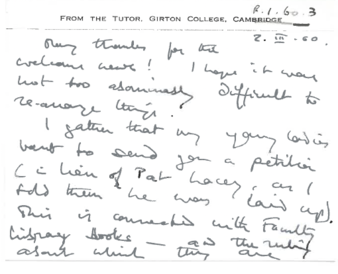

Miss Duke intervenes
Dorothy Thompson, who was a Girton undergraduate in the years 1958-61, recalls that: ‘We had to pay for all meals, so of course we took them.’ But Dorothy adds that all third-year undergraduates could lunch once a week in the Girton Waiting Rooms. These were located at 10-11 St. Edward’s Passage: the premises are now occupied by the Corpus Christi Playroom. Here, a hot lunch was provided daily for Girtonians reading Natural Science, who would of course attend lectures in the morning, followed by lab-work in the afternoon.
The redoubtable and revered Alison Duke (1915-2005) had studied Classics at Girton in 1934-38. She succeeded Norah Jolliffe as Director of Studies in Classics in 1951, and (like Joyce Reynolds of Newnham College) became a University Lecturer in Classics in 1957. Dorothy Thompson recalls that at graduation-time, Miss Duke would test the propriety of her young ladies’ skirt-length by requiring them to kneel on the floor…if the skirt covered the knees, it passed the test!
And, to conclude, a letter of the era might feature a stately diplomatic minuet…
Letter from W.K. Lacey to Dr R.G. Popperwell [Secretary to the Faculty Board of Modern and Medieval Languages] dated 1 February 1962, thanking him for agreeing to ‘reciprocal facilities’ for Classics and MML students in their respective libraries:
Dear Popperwell
Thank you very much for your letter of the 25th January. I am very glad to know that we have now established reciprocal facilities for our respective students. I ought, perhaps, to apologise for having approached your Board through the wrong officer. But the Classical Faculty Librarian is left as a sort of monarch in his own kingdom, and I took the initiative myself without consulting our Faculty Board. It is now the purest coincidence that I happen to be Secretary of our Faculty Board, and so I write to you in this capacity. If there is perchance any offence caused to your Board, I trust you will present my regrets to them.
With good wishes, Yours sincerely,
The Modern and Medieval Languages Library had recently moved into Sir Hugh Casson’s modernistic Raised Faculty Building on the Sidgwick Site, where the Library remains to this day. And, on the evidence of this letter, we may conclude that the spirit of Mazarin, Talleyrand and Metternich still flourished in the Cambridge of 1962!
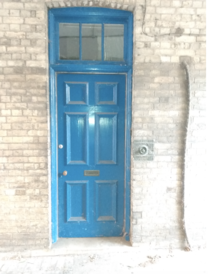
The door of no. 20 Silver Street, which housed the Faculty Office until 1982.
Two Girton alumnae recall their undergraduate days
The Mill Lane feature ‘Girl Meets Boy, 1958’, which went ‘live’ in October 2025, prompted Josephine Flood to write to us. Josephine went up to Cambridge with a scholarship in 1955 to read Classics at Girton College. Isobel Sayers, the headmistress of her independent girls’ boarding school (Lowther College, Bodelwyddan, North Wales) was responsible for both the choice of subject and the choice of institution! Needless to say, Miss Sayers was an old Girtonian…
However, Girton required Josephine to learn more Ancient Greek before coming up to Cambridge, so she spent two terms at the University of Leeds learning the language intensively. She also joined the University’s climbing club, which was open to both men and women, a decision which had a profound influence on her later life. The climbing took place on local cliffs such as those at Ilkley, with some weekend trips to the Lake District.
Josephine says of her Cambridge years: ‘I struggled with Classics and did not enjoy cycling in for lectures etc., trying to avoid catching one’s gown in the wheels, but I enjoyed working on Varsity magazine and weekend trips up to Derbyshire for rock-climbing on gritstone crags.’
In her first book Four Miles High, which was published by Gollancz in 1966 under her maiden name of Josephine Scarr, she remarks that mountaineering ‘…demands no superhuman strength or ability; all one needs is a reasonable head for heights, a sense of balance and a great deal of determination.’ [ibid. p.18].
Undeterred by the fact that the Cambridge University mountaineering club did not at this date admit women, Josephine restarted the Cambridge University women’s mountaineering club. Again, in her book, she says: ‘Occasionally, we would hire a car and go to Wales or the Lake District for a weekend, driving all night Friday and Sunday, arriving back for lectures on Monday morning dirty, tired-out, but happy. Looking back I find it difficult to credit that I could ever have been quite so fanatical, but then there seemed a great sense of urgency, as though the mountains might disappear at any moment.’ [ibid. p.18].
In 1957, Josephine switched to Classical Archaeology for a 2-year Part II. She says: ‘Women were barred from going on field trips at that time, so I missed out on any fieldwork. However, I went with an all-women group of fellow Girtonian Classics students to Greece, and were well looked after by the British School of Archaeology in Athens.’
Josephine would have liked to continue her studies with a Ph.D. in Roman Archaeology, perhaps followed by a teaching or heritage job in Yorkshire (in which county she had been brought up). ‘But sadly at that time women needed a 1st class degree even from Cambridge to go on and do a further degree in the UK.’ Instead, she worked as a climbing instructor in North Wales in 1959-61, before driving a Land Rover overland to India in 1961, where she took part in two women-only Himalaya expeditions. These hazardous but exhilarating experiences are vividly described in her book Four Miles High.
Josephine emigrated to Australia in 1963, where she married an Australian diplomat with whom she had three children, but Josephine also completed a Ph.D. with the Australian National University in Canberra (1973). She subsequently embarked on a distinguished career with the Australian Heritage Commission, where her work had a particular focus on the identification and recording of Aboriginal archaeological sites. Josephine has published a number of books, including: The moth hunters: Aboriginal prehistory of the Australian Alps (1980) and Archaeology of the Dreamtime (1983). She was made a Member of the Order of Australia (AM) in the Queen’s Birthday Honours in 2019, in recognition of her ‘significant service to archaeology, and to the study of Indigenous culture.’
Josephine now lives with her second husband Nigel Peacock, an old Johnian, in a 500-year-old cottage in Snowdonia, where she enjoys visits from her three children and five grandchildren (the eldest of whom is now doing a Ph.D. in History at Oxford).
And Lucy Pollard (Girton 1962) kindly wrote to us in response to the article in the January e-newsletter on the ever-topical subject of missing library books…
‘I so much enjoyed this edition of the newsletter and the continuing saga of Mill Lane (though like Richard Talbert, I thought Mill Lane was a very unattractive building). I’m amused to imagine Donald Robertson’s (I’m one of his grandchildren) relief at finding vol 1 of Chants populaires de la Grèce moderne safely on the shelves.
‘It was also lovely to read about Moses Finley. In my third year, 1964-5, he and David Oates ran a seminar on links between Greece and the Near East, which was a wonderful experience. It was held in the Prioress’s room in Jesus. Seminars in those days were unusual, and such a welcome change from lectures, even if (or perhaps because) they did sometimes hurt one’s brain. John Raven ran one on Plato, also memorable’.
Lucy Pollard (Robertson, Girton 1962)
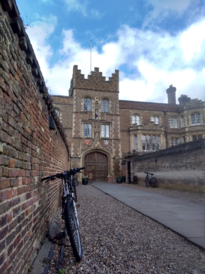
Jesus College, Cambridge.