
In late March, postgraduate researchers from the Cambridge Faculty of Classics travelled to Yale University for the second Yale-Cambridge Roman Empire Workshop. Held over three days in New Haven, Connecticut, the international conference brought together early-career scholars and senior faculty from archaeology, classics, art history, history, and philosophy to examine how ancient societies understood the natural world.
The annual exchange was co-organised by Dr Bill Freeman and Dr Daniel Hanigan, both Research Fellows at Cambridge, alongside Yale Classics professors Benedek Kruchió and Erika Valdivieso. Designed to spark rigorous intellectual debate and offer career development, the workshop builds a direct bridge between researchers at both institutions.
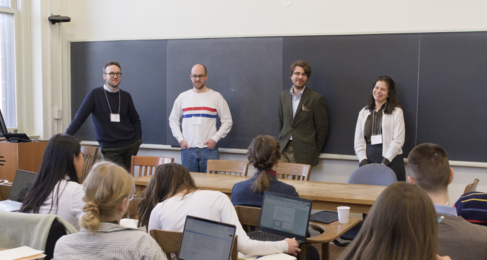
Photo credits: Maria Ma
This year’s theme, ‘Antiquity and Environment’, highlights a major area of research within the Cambridge Faculty: ecocriticism. This field studies ancient literature and material culture through an environmental lens, investigating how human interactions with nature were represented and critiqued. With ecological questions so prominent today, the organisers chose the theme because many postgraduates at both universities are already working on these issues, making it an ideal focus for cross-disciplinary discussion.
"Historians are constructing environmental histories on the impact of volcanoes on the shape of political activity in the Mediterranean, in conversation with people discussing how Roman poets described fields and farms," observed Dr Freeman. "The field is shaping up nicely."
Beyond the academic discourse, the workshop addressed the practicalities of modern academic careers, particularly the frequent movement of researchers across the Atlantic.
"There is so much transatlantic movement on the level of jobs," explained Dr Hanigan. "Once people finish their postgraduate courses in Cambridge or Yale, they often move between the two worlds without much prior contact. Forming these connections while conducting doctoral research, and seeing how different academic cultures tackle these questions, provides a better foundation for approaching the job market."
The partnership is already delivering tangible benefits. Following the inaugural workshop last year, which focused on securing international postdoctoral funding, several attendees successfully obtained fellowships at their partner institutions. Many have maintained active collaborations, sharing application advice and reviewing draft research papers.
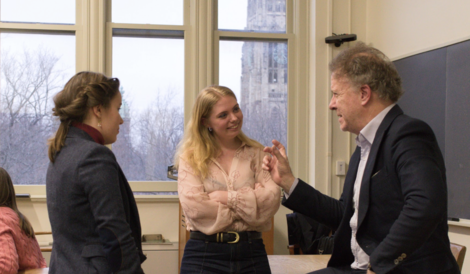
To encourage deep engagement, the workshop paired Cambridge and Yale peers based on overlapping research interests. Rather than reading long papers, each researcher presented a concise overview of their argument, followed by a prepared critique from their partner before the floor was opened to a general question-and-answer session.
The scope of the research presented was broad. Postgraduates debated topics ranging from menstrual taboos in Roman agricultural writing and environmental themes in Ovid, to water infrastructure at Chester’s Roman Fort and Greek accounts of tuna migration patterns. These discussions revealed deeper ancient anxieties regarding human vulnerability to nature, the desire to control the environment, and how these dynamics intersected with gender, class, and status.
The academic schedule also included a archival handling session at the Beinecke Rare Book & Manuscript Library, giving Cambridge participants direct access to rare ancient materials. A keynote lecture by Yale's Professor Joseph Manning demonstrated how cutting-edge paleoclimatological data—such as ice-core analysis—can be combined with historical records to explain political instability and economic shifts in antiquity.
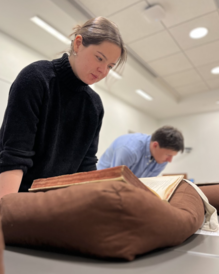
For many Cambridge postgraduates, particularly those on one-year master’s courses or working within tight research budgets, the fully funded exchange provided a valuable opportunity to experience American academic culture, test their ideas internationally, and build networks in a collegiate setting.
Reflecting on the success of the event, Yale’s Dr Erika Valdivieso remarked: "I'm excited to see these relationships grow and develop over the next couple of years. I can honestly say that at dinner, I was so happy to meet people who were not only exceptionally easy to work with, but also a delight to talk to."
The workshop was supported by the MacMillan Center’s Edward J. and Dorothy Clarke Kempf Memorial Fund at Yale, the Faculty of Classics in Cambridge, Trinity College Cambridge, and the Department of Classics at Yale.